
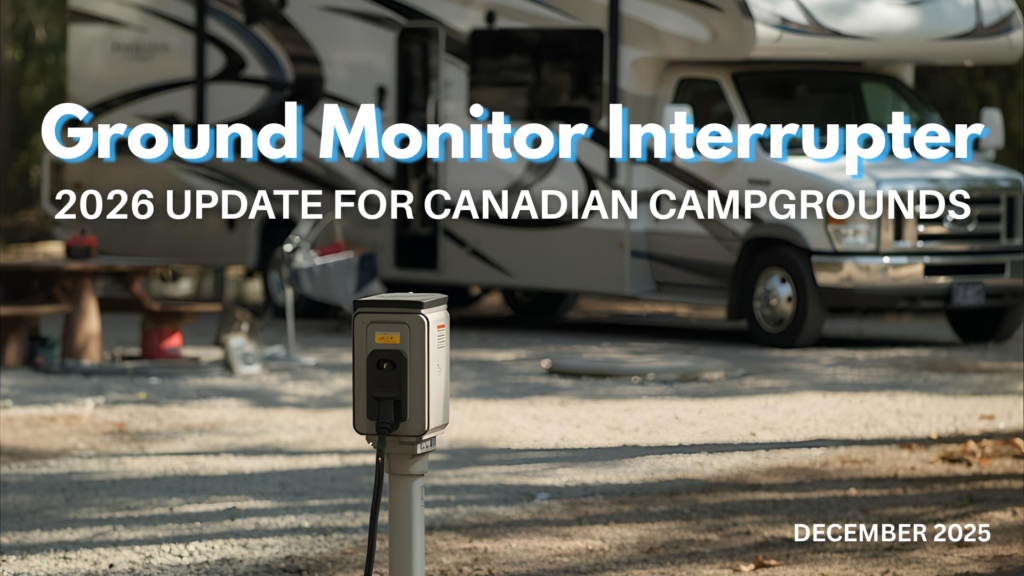
The RV Industry Association (RVIA) has hit pause on enforcing a key new safety requirement for RVs: the Grounding Monitor Interrupter (GMI).
On paper, this looks like “more time.” In reality, it’s a warning shot. The electrical standards are tightening, the technology is coming, and any park with weak infrastructure will feel it sooner or later.
Let’s cut through the noise and talk about what this actually means for Canadian campground owners and the broader RV sector.
A Grounding Monitor Interrupter (GMI) is designed to:
Confirm that a proper ground connection exists before power flows into the RV.
Continuously monitor the ground.
Shut off power if the ground is lost.
In plain terms: GMIs are built to expose grounding problems—at the park pedestal or inside the RV—fast. When they’re widely installed, they will highlight marginal or non-compliant electrical infrastructure in campgrounds very quickly.
Originally, the expectation (driven by the 2023 and 2026 National Electrical Code Article 551) was that all new RVs with 30A or 50A service would need GMIs by January 1, 2026.
RVIA has now:
Delayed enforcement of the GMI requirement.
Confirmed it will adopt the 2026 NEC, but exclude the GMI article for now because:
There aren’t enough fully developed, listed GMI products on the market.
Manufacturers and suppliers need more time for product validation and field testing.
RVIA has signaled that GMI enforcement will likely align with the start of the 2028 model year (around mid-2027), but that’s not a final date. It will be revisited as product availability and testing catch up.
At the same meeting, RVIA also put timelines in place for other standards (NFPA 1192 and ANSI/RVIA DC Voltage Systems in RVs) with effective and enforcement dates in 2026. The message is clear: standards are moving forward; GMI is just on a slower track.

This is where it lands for you as an operator or stakeholder in Canada.
Don’t plan your operations on the assumption that every new rig rolling in by 2026 will have a GMI. That won’t be the case.
For at least the next couple of seasons, the RV fleet will remain a mix of:
Units with no GMI.
Early adopters with GMI-style technology.
Future models that phase it in as manufacturers ramp up.
The delay doesn’t make aging or under-spec park wiring any safer. It just means the technology that would have exposed those issues at scale is coming later.
If your park already has:
Questionable grounding,
Old pedestals,
Patchwork electrical work,
you still have a risk profile that hasn’t improved just because an enforcement date moved.
Viewed strategically, the delay is breathing room:
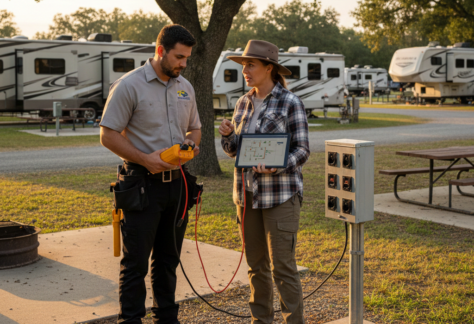
Time to audit your electrical systems.
Time to prioritize upgrades in your capital plan.
Time to lock in contractors and suppliers before demand spikes when GMIs become mainstream and parks start scrambling.
If you wait until GMIs are everywhere in the RV fleet, you’ll be reacting under pressure—with frustrated guests standing at your office saying, “My RV keeps losing power here but not anywhere else.”

Here’s how to turn this delay into an advantage instead of a future headache.
Bring in a qualified professional and get a reality check on:
Grounding and bonding integrity.
Condition of pedestals, wiring, and panels.
High-risk sections of the park (older loops, legacy repairs, etc.).
Document the findings. Build a multi-year upgrade roadmap instead of trying to do everything in one expensive sprint.
If your approach to electrical issues is mostly reactive—fixing whatever breaks—that won’t hold up in a GMI world.
Lock in:
Scheduled inspections of pedestals and distribution equipment.
Clear SOPs for how staff respond to “no power” or “it keeps tripping” complaints.
A process to differentiate between:
Genuine park issues, and
Problems originating in the RV itself.
Start the conversation early with:
Electrical contractors,
Equipment suppliers,
Insurers and risk advisors.
Key questions:
How are they preparing for GMIs?
What infrastructure upgrades do they recommend for your park profile?
Are there insurance or risk management implications once GMIs become common?
If you’re proactive, you’ll be ahead of the curve when other parks start crowding the same trades and vendors.
As GMIs roll out:
Guests will show up with units that cut power when they sense grounding issues.
Front-line staff need a script and a process—not guesswork.
That means:
Basic training on what GMIs are and what they do.
Clear guidance on what staff can troubleshoot and when to escalate.
Standard communication to guests: calm, factual, and consistent.
CCRVA is tracking these standards developments closely and will:
Maintain active dialogue with RVIA and other North American partners as GMI enforcement timelines evolve.
Factor this into our education, technical guidance, and advocacy work for Canadian campgrounds.
Develop and promote resources—webinars, checklists, and practical guides—focused on:
Electrical safety and infrastructure,
Risk management,
Funding and planning for upgrades where possible.
As timelines firm up and products hit the market at scale, we’ll translate that into clear, actionable guidance—not just technical jargon.
The GMI enforcement delay is not a signal to relax. It’s a signal to prepare.
The direction of the industry is non-negotiable: tighter electrical safety, higher expectations, less tolerance for marginal infrastructure.
Parks that use this window to get ahead—auditing, planning, upgrading—will be in a strong position when GMIs become widespread.
Parks that treat this as a “problem for later” will feel the impact in guest experience, downtime, and potential liability.
CCRVA will continue to keep you informed as this evolves and help you turn regulatory change into a strategic advantage, not a surprise crisis.
If you’d like support in mapping out a phased plan for your park, reach out—we can help you break this down into concrete, manageable steps.